Intermittent Faults Need Receipts: Recording the Problem Your Mechanic Can't Reproduce
There is a certain look that crosses a driver's face when the car that was misbehaving all weekend suddenly behaves perfectly in the garage car park. It is part embarrassment, part fury. The mechanic gets a vague description, the car gets a quick road test, and everyone goes home none the wiser. A week later, the warning light is back.
Intermittent faults are not imaginary. They are simply bad at turning up on cue. A sensor can fail only when it is hot, a wiring plug can lose contact over a bump, and a pump can complain only on a cold start. The trick is to stop treating the fault as a ghost story and start treating it as a case to build. You do not need to diagnose it yourself. You do need to leave a paper trail.
A fault that clears is still a fault
Plenty of drivers talk themselves out of booking a repair because the problem vanished. That is understandable, especially when money is tight. But a fault that appears and disappears is often telling you something useful: it is conditions-dependent. Cold mornings, damp weather, stop-start traffic, a certain speed, a turning manoeuvre, or a heavy load can all be part of the trigger.
The garage's job is to reproduce those conditions and test the right system. Your job is to tell them what those conditions were. Without that, a mechanic is left checking the obvious and hoping for the best. That is not laziness; it is just detective work with half the notes missing.
Know when to stop gathering evidence
Before we go any further: evidence collection is not a reason to keep driving a car that feels unsafe. If a red warning light appears, if the brakes feel odd, if there is smoke, a strong fuel smell, or the steering changes character, pull over somewhere safe and get proper help. A phone video is not worth a risk on a wet A-road.
Limp mode is another line in the sand. One brief flash might justify a gentle drive to a garage. Repeated limp-mode episodes are the car telling you to stop treating it as a commuting experiment. Record what you can, then arrange recovery or a booked inspection.
The glovebox fault diary
You do not need a leather-bound logbook. A notes app on your phone is fine. The point is to record the details while they are fresh, not three days later when all you remember is that it made a funny noise near the roundabout.
For each episode, note the date and rough time, the weather, whether the engine was cold or warm, the speed and road type, what you were doing when it happened, and exactly what you saw, heard or smelled. Add whether the warning light stayed on, flashed, or cleared itself. If the car went into limp mode, say so. If it cleared after a restart, say that too.
Keep the language plain. 'Juddering under light acceleration at about 40mph on a slight incline' is far more useful than 'driving badly'. 'Petrol smell after filling up, only when the tank is full' gives a mechanic a direction. 'It does it sometimes' gives them a shrug.
Video is good, but only if it is safe
A short clip can be worth a hundred words, especially for noises. A rattle, a whine or a tick is difficult to describe and easy to demonstrate. Have a passenger film if possible. If you are on your own, do not hold a phone while driving. Pull over safely and record the symptom while stationary, or set up a properly mounted phone before you set off.
Film the dashboard and the road ahead if it helps show the conditions, then narrate what is happening. Keep clips short and label them. Ten clips called 'noise' are less useful than one clip called 'cold start rattle, 7am, lasts 30 seconds'. If the fault is a warning message, photograph the screen before it disappears. If it is a vibration, a passenger might feel it better than a camera can show it.
Capture the conditions, not just the symptom
Mechanics think in patterns. Does it happen when the engine is cold, hot, damp, under load, at idle, on full lock, or over speed bumps? Does it appear after a short trip or a long one? Is the fuel level low or high? Was the air conditioning on? Did it happen after filling up, after a jet wash, or after the car sat for a few days?
Those details matter. A misfire that appears only in damp weather points one way. A vibration that appears only at 60mph points another. A warning light that appears only when turning left could be a wheel-speed or wiring issue. You are not expected to know the answer. You are expected to hand over the clues.
Fault codes are useful, but do not wipe them
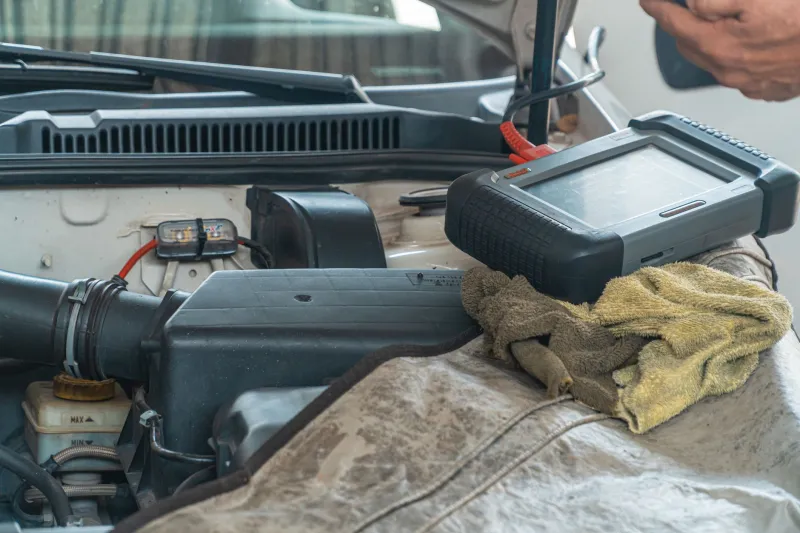
If you own a basic OBD scanner, you can read stored and pending codes. Photograph the screen. Do not clear the codes before the garage sees the car. Clearing them wipes useful freeze-frame data and can make a genuine fault look like it never happened. If you are not confident with a scanner, leave it alone. A garage would rather see a messy trail than a clean slate.
Remember that not every intermittent fault stores a code. A tired bush, a loose trim clip or a failing relay may never trouble the ECU. That is another reason your notes and clips matter.
Hand it over like a case file
When you book the car in, say clearly that the fault is intermittent and ask for a diagnostic session, not a guess. Bring your notes, your clips and any photos. A one-page summary is ideal: symptom, when it happens, what you have already tried, and what you do not want done without approval.
Ask the garage to check stored codes before anything is cleared, and agree what happens if they cannot reproduce the fault. A road test, live data, an overnight stay, or a return visit when the symptom is active may be the sensible next step. Diagnostic time is real work, so expect to pay for it. The difference is that you are paying for a focused investigation rather than a lucky dip.
Intermittent faults are annoying, but they are not unbeatable. Give your mechanic something concrete and you turn a ghost story into a repair order. That is better for your wallet, better for your car, and much better than another Tuesday morning shrug.