Don’t Buy the Sensor Yet: How to Read an OBD Code Like a Mechanic

You’ve done the responsible thing. The engine management light came on, you bought a cheap code reader or borrowed one from a mate, and you’ve arrived at the garage with a printout and a parts list. The printout says P0420. The internet says catalytic converter. Your mate says lambda sensor. The bloke at the motor factors says he’s got one on the shelf.
All of that might be useful. None of it is a diagnosis.
A fault code is the car telling you where it has noticed a problem, not why the problem exists. Think of it as a smoke alarm going off. The alarm is real. The toast might be the cause, or it might be a wiring fault in the kitchen. Replacing the alarm because it made a noise is not a repair.
A code is a complaint, not a confession
Modern cars monitor themselves constantly. The engine control unit watches sensors, compares readings with expected values and sets a code when something drifts outside the programmed limits. That’s why you get codes like P0420 — catalyst efficiency below threshold — or a glow-plug circuit fault on a diesel.
P0420 is a good example. It does not mean “fit a catalytic converter”. It means the ECU has seen the rear oxygen sensor behaving in a way that suggests the catalyst isn’t doing its job properly. The cause could be a failing catalyst, but it could also be an exhaust leak, a tired oxygen sensor, a misfire, a fuel mixture problem, or even a wiring issue. Fitting a new catalyst because a code reader said so is an expensive guess.
Glow plugs are similar. A code might point to a glow-plug circuit, but the plug itself may be fine. The fault could be in the wiring, the relay, the control module or the connection. A mechanic needs to test the circuit, not just read the code and order four new plugs.
This is why the trade sometimes talks about “parts cannon” repairs: firing parts at a car until the light goes out. It’s expensive for you and frustrating for everyone. A good garage will use the code as a starting point, then do the boring bit — testing.
What should happen after the code is read
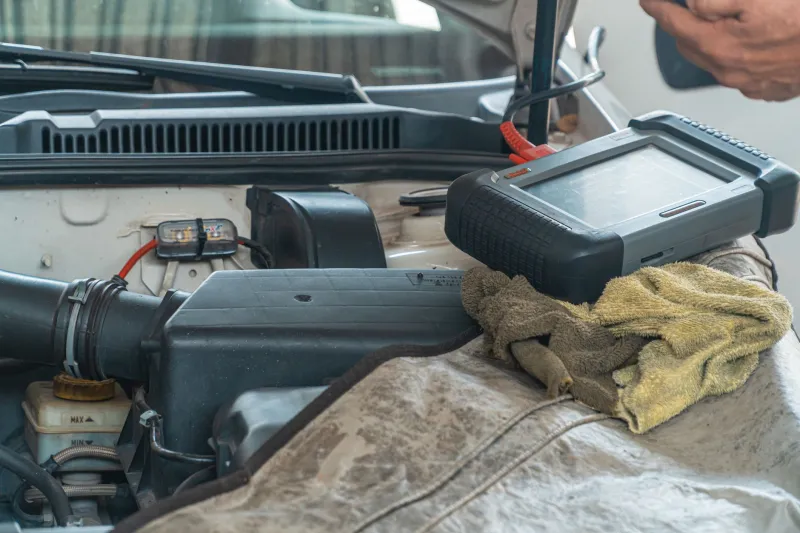
First, the garage should scan all the relevant control modules, not just the engine. A code in one system can be triggered by something in another. They should also look at freeze-frame data, which is a snapshot of what the engine was doing when the fault was stored: speed, temperature, load, fuel trims and so on. That snapshot often narrows things down faster than the code itself.
Then comes live data. A mechanic might watch oxygen sensor readings, fuel trims, coolant temperature and misfire counters while the engine runs. They might check the wiring with a multimeter or oscilloscope, do a smoke test for inlet leaks, or inspect the exhaust for blow-by. On a glow-plug fault, they might check resistance and voltage drop at the plug and work back through the circuit.
That takes time and equipment. It is not always glamorous. But it is how a £20 sensor turns into the right £20 sensor instead of a £400 catalytic converter that didn’t need fitting.
The internet parts list problem
Online advice is often based on a different engine code, a different market or a car that had three other faults at the same time. UK trim levels and engine variants can differ from what a forum thread describes. A generic “replace the MAF” answer may be useless if your car’s fault is a split intake hose.
There’s also the quality question. Cheap sensors can be false economy, especially on modern cars that are fussy about signal quality. A garage may recommend a known-brand part for good reason. That doesn’t mean you can’t ask about price, but it does mean the cheapest part on an auction site isn’t automatically the smart buy.
Questions to ask before you authorise the work
You don’t need to be a technician to have a sensible conversation. Before you say “go ahead”, ask:
- What tests have been done, and what did they show?
- Is the fault currently present, or is it stored from an old event?
- What is the freeze-frame data telling you?
- If we replace this part and the light comes back, what happens next?
- Is the diagnosis charge separate, and is any of it credited against the repair?
- What warranty comes with the part and the labour?
A good garage should be able to explain the reasoning in plain English. They don’t have to give you a lecture on signal voltage, but they should be able to say “we tested the circuit and the plug is open-circuit” or “the fuel trims show it’s running lean, and we’ve found a split hose”. If the answer is only “the code says so”, that’s a red flag.
Diagnosis is money well spent — when it’s done properly
Paying for diagnostic time can feel annoying when you just want the light off. But a proper diagnosis is often the cheapest part of the job. It stops you buying parts you don’t need and helps you decide whether a repair is worth doing at all.
So bring your printout. Bring your research. Just don’t bring a boxed sensor and expect the garage to fit it as a cure. The code gets you to the right bay. Testing gets you to the right repair. Those are two different things, and the gap between them is where money gets wasted.